Hellraiser, and other custom cartridge ideas
Moderator: Moderators
Hellraiser, and other custom cartridge ideas
I don't know if any of you have noticed, but the BEN is looking for a little help building a custom catridge along the same lines as the hardware for the Color Dreams game Hellraiser. The game was never finished, but the hardware was supposedly done. I noticed something very cool about this design idea. If the Helraiser hardware could be coupled with a memory card and a micro-processor, one could make an emulator which runs inside a real NES. Its an emulator because it emulates cartridge hardware, not NES hardware. Not only could you emulate hardware for NES carts, but it could also be possible to make emulators for older systems like Atari 2600 work too, since this cart would make true raster graphics on the NES possible.
Nice! That would actually be a godsend for some of us. XD.
Also, I'm wondering, would this make it possible to bring over some of the SNES's effects in some fashion?
I'm thinking Mode 7, or even some limited SuperFX-type 3D. The equation for Mode7 is easy enough, if I remember, just...it has to be done a lot for each pixel, if I remember right.
SuperFX though...not so sure it could be done...but I've seen C-64 with limited 3D like that, at lower framerates, and it used a 6502 variant with 64K RAM (Same RAM as the Hellraiser cart). THere's even a 3-D Pacman game with bitmap ghosts.
(THE FOLLOWING ARE IDEAS WHICH MAY OR MAY NOT BE PLAUSIBLE. PLEASE DO NOT FLAME.)
Plus, handling graphics with a Z80 might work as well. I don't know if the Z80 handled the drawing and color pallette of the Master System, but it was capable of 64 colors I think.
NES colors, I think, are normally limited to 32 total color pallette, 16 on screen, 4 per sprite, 4 per 32x32 background tile. Of course, if the NES is somehow "tricked" into drawing the bitmaps in a multi-tile format, we might be able to make more than 4 colors, as long as each 32x32 pixel tile only had 4 colors. We could get up to 16 colors, minus unrepeated colors in the background, without even any sort of fast switching methods.
Plus, it might be possible, though it'd put a strain on the PPU, to swap colors every fraction of a second to make the illusion of multitudes of color. I don't know what this would entail though, but it would need a sort of color switching program, or several bitmaps with different colors to switch through.
For example. Say 4 colors are used on a tile. say you want more colors and to switch back and forth between the tiles.
The tiles' colors could switch every 1/25 or 1/30th of a second, (depending on PAL or NTSC) and you could wind up with 4^2 color possibilities, or 16 per sprite. Remembering that computer movies are recorded in as low as 15 or 20 FPS on occasion, it may be doable. In fact, you might be able to cycle through 3 sets of pellettes every 1/17th or 1/20th of a second to trick the eye into seeing 4^3 colors on the tile, for 64 possible colors for a sprite, giving sprites similar in color to the Master System. Any kind of blurring between the colors could only help. XD Of course, this may be a burden on the PPU. I don't know if it is plausible or not.
Also, this would mean that the game would need up a CHR ROM size up to 2x or 3x normal size. However, that is likely doable for most games.
This is all guessing though, because though I know some of the basic NES capabilities, I do not know the software at all.
EDIT: I've made an example. I made an example at 1/20th of a second, though it will onlt show at 1/10th of a second on some browsers (IE), blending 2 colors to make a third middle color. Normally, crosshatching is AWFUL on the NES, but by making switching and opposite crosshatches, here's what I did. The first and second frames are the solid colors used.
First frame...
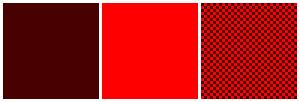
Second frame...
Animated picture.

I know it can be noticed a little more prominently, but imagine this through an RF or standard AV video. ^^ The blurring would actually HELP mask the switching. Also, these have been resized to look larger. The original animation was 32 x 32 pixels. Also, remember, in games, there is more than one flat object, so your eye may be too distracted to notice the very minute flicker that MIGHT happen.
Also, I'm wondering, would this make it possible to bring over some of the SNES's effects in some fashion?
I'm thinking Mode 7, or even some limited SuperFX-type 3D. The equation for Mode7 is easy enough, if I remember, just...it has to be done a lot for each pixel, if I remember right.
SuperFX though...not so sure it could be done...but I've seen C-64 with limited 3D like that, at lower framerates, and it used a 6502 variant with 64K RAM (Same RAM as the Hellraiser cart). THere's even a 3-D Pacman game with bitmap ghosts.
(THE FOLLOWING ARE IDEAS WHICH MAY OR MAY NOT BE PLAUSIBLE. PLEASE DO NOT FLAME.)
Plus, handling graphics with a Z80 might work as well. I don't know if the Z80 handled the drawing and color pallette of the Master System, but it was capable of 64 colors I think.
NES colors, I think, are normally limited to 32 total color pallette, 16 on screen, 4 per sprite, 4 per 32x32 background tile. Of course, if the NES is somehow "tricked" into drawing the bitmaps in a multi-tile format, we might be able to make more than 4 colors, as long as each 32x32 pixel tile only had 4 colors. We could get up to 16 colors, minus unrepeated colors in the background, without even any sort of fast switching methods.
Plus, it might be possible, though it'd put a strain on the PPU, to swap colors every fraction of a second to make the illusion of multitudes of color. I don't know what this would entail though, but it would need a sort of color switching program, or several bitmaps with different colors to switch through.
For example. Say 4 colors are used on a tile. say you want more colors and to switch back and forth between the tiles.
The tiles' colors could switch every 1/25 or 1/30th of a second, (depending on PAL or NTSC) and you could wind up with 4^2 color possibilities, or 16 per sprite. Remembering that computer movies are recorded in as low as 15 or 20 FPS on occasion, it may be doable. In fact, you might be able to cycle through 3 sets of pellettes every 1/17th or 1/20th of a second to trick the eye into seeing 4^3 colors on the tile, for 64 possible colors for a sprite, giving sprites similar in color to the Master System. Any kind of blurring between the colors could only help. XD Of course, this may be a burden on the PPU. I don't know if it is plausible or not.
Also, this would mean that the game would need up a CHR ROM size up to 2x or 3x normal size. However, that is likely doable for most games.
This is all guessing though, because though I know some of the basic NES capabilities, I do not know the software at all.
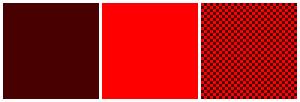
EDIT: I've made an example. I made an example at 1/20th of a second, though it will onlt show at 1/10th of a second on some browsers (IE), blending 2 colors to make a third middle color. Normally, crosshatching is AWFUL on the NES, but by making switching and opposite crosshatches, here's what I did. The first and second frames are the solid colors used.
First frame...
Second frame...
Animated picture.
I know it can be noticed a little more prominently, but imagine this through an RF or standard AV video. ^^ The blurring would actually HELP mask the switching. Also, these have been resized to look larger. The original animation was 32 x 32 pixels. Also, remember, in games, there is more than one flat object, so your eye may be too distracted to notice the very minute flicker that MIGHT happen.
Warranty-Voiding fun!
