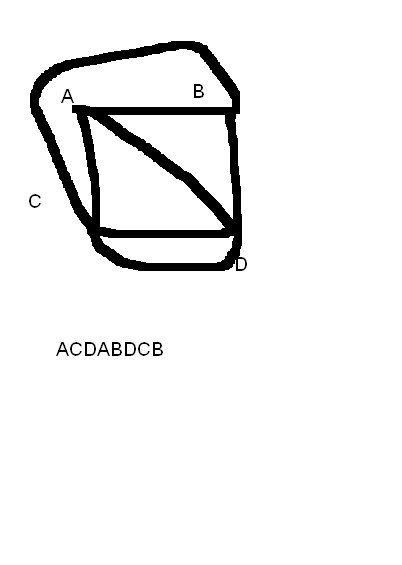
Definitely impossible. Using some logic posted here, you'd need to start in the centre (the middle of the X), cross through the diagonal, and finish on the second half of the X you started with. Simply put, it can't be done.
Thought this was interesting: (Taken from:
http://plus.maths.org/issue25/features/budd/)
David Hilbert
David Hilbert was probably the greatest mathematician of the end of the 19th and beginning of the 20th centuries. Among his many mathematical achievements can be included profound discoveries in logic, algebra and differential equations. Hilbert spaces, a special type of vector space, form the basis for the whole of quantum mechanics.
Hilbert was invited to speak at the International Congress of Mathematicians held in Paris in the year 1900. He could have given a (dull) talk on the achievements of mathematicians in the 19th century, but instead he did something far more interesting. At the start of the 20th century, Hilbert decided to throw out a challenge to keep mathematicians busy for the next 100 years. His talk comprised 23 problems, now called the Hilbert problems, the attempts to solve which he believed would stimulate 20th century mathematics and mathematicians. He chose his problems well. Not only have they proved immensely challenging to solve, but they have led to an enormous amount of new mathematics. Anyone who solved one of the Hilbert problems became extremely famous (within the mathematical community), but not necessarily very rich. Most of the Hilbert problems have now been solved. One which lasted until nearly the end of the 20th Century was Fermat's last theorem.
Pierre de Fermat was an Italian mathematician who worked in the 16th century and was interested in number theory. This is (essentially) the study of problems involving the natural numbers 1,2,3,…. A test for prime numbers based on one of Fermat's results called Fermat’s little theorem has just been discovered, and could play an important role in modern cryptography. It has been known since ancient times that you could find natural numbers $a$, $b$ and $c$ with $a^2 + b^2 = c^2$, an example being $3^2 + 4^2 = 5^2.$ In contrast, Fermat had managed to show that you couldn’t find natural numbers with $a^4 + b^4 = c^4$, using a method he called steepest descent. He wondered whether, if $n$ was any integer different from 2, the problem
[ a^ n + b^ n = c^ n ]
had any whole-number solutions. While thinking about this he retreated to a library and read Diophantus's Arithmetica. It is not recorded whether he liked the text of the book, but he certainly did not like its margins - or to be more accurate the size of them. We know this because he wrote in the margin that he had found a truly marvellous proof of the fact that the above problem could not be solved, but unfortunately the margin of the book was too small to write it down. Did he have a proof? To be honest, we don't know, and mathematicians have been trying hard ever since to find out (with extra points to be awarded to any proof that would fit into a book margin). The problem gained such notoriety that it was called Fermat’s last theorem.
Hilbert posed exactly this problem as one of his unknown problems at the start of the 20th century, and bang on cue, almost 100 years later, it was solved by Andrew Wiles as part of his proof of the Tatyana-Shumura conjecture. Fermat was right (but Wiles' solution will not fit into a margin). You can read about the story of this problem in the wonderful book Fermat's last theorem by Simon Singh.
Another of Hilbert's problems was the Riemann Hypothesis, which is not only still unsolved, but is generally regarded as the most important unsolved problem in mathematics. You can find out more about this problem in A whirlpool of numbers, also in this issue of Plus.
Problems:
TWO BUCKS AND A FLY:
Two bucks, vying for the attention of a young doe standing nearby, lowered their antlers and came hurtling toward each other from a distance apart of 100 meters, each at a speed of 12.5 meters per sec.
A super-fast, but crazy, deer-fly flew in a straight line from the head of one buck to the head of the other, turned and flew back to the first buck. It continued to fly back and forth between the two bucks as the distance between them became dangerously shorter. The fly's speed was 80 meters per sec. How many meters had the fly traveled when the two bucks eventually made contact?
When teacher asked Penny Bright for her place and date of birth she quickly replied "I was born in London at exactly 25 minutes and 4 seconds before Big Ben struck one on the afternoon of the 7th day of August in the year 1990."
The teacher was amazed. "Goodness. How can you remember all that information after all these years". Penny has a method. How does she remember?
Farmer Newer had two poles erected on his land, one was 74 feet high and the other 100 feet high.
He attached a 114 foot length of rope from the top of one pole to the top of the other. The rope sagged so that its lowest point was 30 feet above the ground. What distance apart are the poles?