Does anyone know of anything existing along the lines of a fingerless controller? Does any design exist? Has the concept ever been pursued before? I would like to create one for my brother who is in a wheelchair and unable to use his fingers.
I have an idea or two.. but I'm not sure if they are realistic or not
Fingerless Controller
Moderator: Moderators
-
extremesonic
- Moderator
- Posts: 530
- Joined: Fri Feb 04, 2005 12:38 pm
- Location: St.Kits
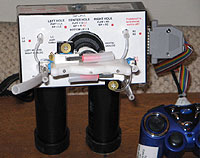
I remember awhile back, there was a GBA adapter made, so you could play it with your tongue/mouth. It was like a laptop mouse pad and all the buttons/d-pad were controlled by different points on the pad.
http://www.play-gadgets.com/2006/08/10/ ... ur-tongue/
http://www.play-gadgets.com/2006/08/10/ ... ur-tongue/
SNESp - 100%
Protable X - 15% - I need money
Protable X - 15% - I need money
Fingerless controllers
Hi Rhionin,
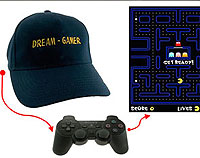
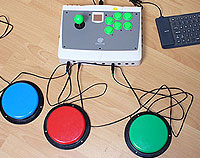
As for connecting tailor made controls - this is pretty easy too. I'm doing that right now for a completely accessible Playstation 2 controller: http://switchgaming.blogspot.com/2007/1 ... eluxe.html - This set up allows you to connect additional controls pretty much however you want.
It's quite easy to do to - using an Ultimarc iPac board: http://www.ultimarc.com/ipac1.html. Going the D.I.Y. route is generally going to be the cheapest option. I plan to get some nice D.I.Y. pages up soon to aid with this. E-mail me through my web-site if you'd like to talk more about this.
Meanwhile - this is pretty fantastic news for one-handed gamers: http://benheck.com/10-24-2007/benhecks- ... r-revealed
Yes, definitely! There are a number of head controllers that might work well. Take a good look around the "Accessible Gaming Shop" here: http://www.oneswitch.org.uk/1/AGS.htm. Especially look at the "Head, Mouth and Eye" controls section. There is a QuadController and DreamGamer unit that may be of use.Does anyone know of anything existing along the lines of a fingerless controller? Does any design exist? Has the concept ever been pursued before? I would like to create one for my brother who is in a wheelchair and unable to use his fingers.
As for connecting tailor made controls - this is pretty easy too. I'm doing that right now for a completely accessible Playstation 2 controller: http://switchgaming.blogspot.com/2007/1 ... eluxe.html - This set up allows you to connect additional controls pretty much however you want.
It's quite easy to do to - using an Ultimarc iPac board: http://www.ultimarc.com/ipac1.html. Going the D.I.Y. route is generally going to be the cheapest option. I plan to get some nice D.I.Y. pages up soon to aid with this. E-mail me through my web-site if you'd like to talk more about this.
Meanwhile - this is pretty fantastic news for one-handed gamers: http://benheck.com/10-24-2007/benhecks- ... r-revealed
NES Hands Free controller
Yes, you're right. It was called the Hands Free controller, and was the first games console controller aimed squarely at a disabled gamer manufactured by a mainstream gaming company.
These are extremely hard to come by. I'd love to get hold of one for historical purposes, and to show off at events supported by the IGDA's GASIG (Game Accessibility Special Interest Group): http://www.igda.org/accessibility
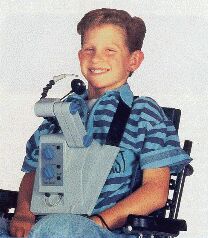
More here: http://www.oneswitch.org.uk/2/pioneers.htm
These are extremely hard to come by. I'd love to get hold of one for historical purposes, and to show off at events supported by the IGDA's GASIG (Game Accessibility Special Interest Group): http://www.igda.org/accessibility
More here: http://www.oneswitch.org.uk/2/pioneers.htm
-
17daysolderthannes
- Posts: 381
- Joined: Thu Oct 18, 2007 7:15 am
Re: NES Hands Free controller
although, as a plus, I've heard they are super cheap if you do come across one. Since the NES is ~15 years out of production and the only people interested in them is disabled people you would kind of have to be a dick to charge a lot for them. The only downside is NES games are hard sometimes with an able bodied person and a normal controller, trying to play with a sip and puff controller would have me screaming every explicative imaginable in about 2 minutes. I guess having a game genie and invincibility codes would help a lot.OneSwitch wrote:Yes, you're right. It was called the Hands Free controller, and was the first games console controller aimed squarely at a disabled gamer manufactured by a mainstream gaming company.
These are extremely hard to come by. I'd love to get hold of one for historical purposes, and to show off at events supported by the IGDA's GASIG (Game Accessibility Special Interest Group): http://www.igda.org/accessibility
More here: http://www.oneswitch.org.uk/2/pioneers.htm
Edit by mod: Do NOT bypass the language filter, it's in place for a reason. You've been warned.
-
Sangheilios
- Posts: 18
- Joined: Mon Aug 20, 2007 8:57 pm
Those all suck... the way to do it is not to replace the fingers with horribly inept body parts like the tongue or feet, but to completely bypass physical manipulation. Brainwaves (thoughts) being translated directly into digital reactions is the key. Basically, you need special hardware to interface the wetware with the software. This can be done invasively or passively.
Invasively, a microchip is implanted in the wetware (brain). This technique has the potential to be much more powerful than current passive methods, but is expensive and licensed only for disabled persons in special test cases. See here: http://medgadget.com/archives/2006/10/t ... plays.html
Noninvasively, the technology was very primitive and not really useful until the past few years. The technology has been in development since the first "skullcap" or "braincap" in 1970. Recent advances have made it sophisticated enough to fully control modern 3D games purely by thought. It is also now affordable to most, and Emotiv's Project Epoc, their premier non-invasive neural interface device, will launch in late 2008. At the time when PS3s cost $600, they stated their NID would cost "less than a PS3." The only problem is the decoding process takes some time, so there is some slight lag when thinking in 3D (like using the analog sticks), so for hardcore gamers the device is currently reccommended for performing all other functions like melee, use, activate, switch weapon, jump, crouch, enter cover, etc. Here're two links to Epoc: www.youtube.com/watch?v=YxMux4uEkLI
www.emotiv.com/2_0/2_1.htm
Eventually, this technology will be common enough to be the ONLY technology, and we will all have neural implants or miniaturized external devices (for the squeamish and those who are medically unable to safely undergo the implantation surgery). Perhaps, we may even drive our smartcars of the future with our minds, although that will be quite some time from now I expect. But we're about to have the option to put down the controller forever.
Invasively, a microchip is implanted in the wetware (brain). This technique has the potential to be much more powerful than current passive methods, but is expensive and licensed only for disabled persons in special test cases. See here: http://medgadget.com/archives/2006/10/t ... plays.html
Noninvasively, the technology was very primitive and not really useful until the past few years. The technology has been in development since the first "skullcap" or "braincap" in 1970. Recent advances have made it sophisticated enough to fully control modern 3D games purely by thought. It is also now affordable to most, and Emotiv's Project Epoc, their premier non-invasive neural interface device, will launch in late 2008. At the time when PS3s cost $600, they stated their NID would cost "less than a PS3." The only problem is the decoding process takes some time, so there is some slight lag when thinking in 3D (like using the analog sticks), so for hardcore gamers the device is currently reccommended for performing all other functions like melee, use, activate, switch weapon, jump, crouch, enter cover, etc. Here're two links to Epoc: www.youtube.com/watch?v=YxMux4uEkLI
www.emotiv.com/2_0/2_1.htm
Eventually, this technology will be common enough to be the ONLY technology, and we will all have neural implants or miniaturized external devices (for the squeamish and those who are medically unable to safely undergo the implantation surgery). Perhaps, we may even drive our smartcars of the future with our minds, although that will be quite some time from now I expect. But we're about to have the option to put down the controller forever.
Not convinced. I do think this technology will be great for some people and for some games. Not all, and certainly not with what I've seen to date (including your links).
Have you actually tried to play a game with this type of technology? It's not easy. I can't see this stuff suiting learning disabled gamers for this reason - brain implant or not.
I also think you underestimate what some disabled gamers can achieve using different parts of their body.
I applaud your optimism though. Maybe one day...
Have you actually tried to play a game with this type of technology? It's not easy. I can't see this stuff suiting learning disabled gamers for this reason - brain implant or not.
I also think you underestimate what some disabled gamers can achieve using different parts of their body.
I applaud your optimism though. Maybe one day...
The guy is looking for an easy solution, not surgery.Sangheilios wrote:Those all suck... the way to do it is not to replace the fingers with horribly inept body parts like the tongue or feet, but to completely bypass physical manipulation. Brainwaves (thoughts) being translated directly into digital reactions is the key. Basically, you need special hardware to interface the wetware with the software. This can be done invasively or passively.
Invasively, a microchip is implanted in the wetware (brain). This technique has the potential to be much more powerful than current passive methods, but is expensive and licensed only for disabled persons in special test cases. See here: http://medgadget.com/archives/2006/10/t ... plays.html
Noninvasively, the technology was very primitive and not really useful until the past few years. The technology has been in development since the first "skullcap" or "braincap" in 1970. Recent advances have made it sophisticated enough to fully control modern 3D games purely by thought. It is also now affordable to most, and Emotiv's Project Epoc, their premier non-invasive neural interface device, will launch in late 2008. At the time when PS3s cost $600, they stated their NID would cost "less than a PS3." The only problem is the decoding process takes some time, so there is some slight lag when thinking in 3D (like using the analog sticks), so for hardcore gamers the device is currently reccommended for performing all other functions like melee, use, activate, switch weapon, jump, crouch, enter cover, etc. Here're two links to Epoc: www.youtube.com/watch?v=YxMux4uEkLI
www.emotiv.com/2_0/2_1.htm
Eventually, this technology will be common enough to be the ONLY technology, and we will all have neural implants or miniaturized external devices (for the squeamish and those who are medically unable to safely undergo the implantation surgery). Perhaps, we may even drive our smartcars of the future with our minds, although that will be quite some time from now I expect. But we're about to have the option to put down the controller forever.

-
Sangheilios
- Posts: 18
- Joined: Mon Aug 20, 2007 8:57 pm
Well, you don't need surgery... I was just giving some background info on the technology. Mainly I was talking about Emotiv's device that releases next year. Maybe my post was too optimistic. I know at first it will be hard to adjust to. You have to train your thoughts in a completely new way. You begin to move (virtual) objects with your mind, like you're learning telekinesis but for real.
But maybe you meant that even with time to acclimate to the new control method, the technology just isn't good enough yet. Well, I agree. The technology, after 40 years, is still in its infancy. But I expect major leaps ahead in the coming decades. Now that we have mapped the human genome, mapping out the brain and all its functions is the next great project that is currently being worked on in some scientific circles.
I keep up with this area of science because I think of it as an example of technology retroactively making myths like telepathy real. Once it is perfect, however long that takes, it will naturally be the only input method. Imagine going through life, pressing X to enter vehicle, A to jump, analog click to enter run mode. If videogames want to simulate reality, all that eventually has to go.
If you've read any of the distant future projections, you'll know that eventually we could communicate anywhere on this planet through wireless thought transmission. And read each others' minds, control people with neural implants, download memories and knowledge, and have supercomputational power augmented into our thoughts. We could download our chemical brain structures to a computer, and live forever in a thought-controlled android body. Once again, this is all plausible because I'm talking like centuries from now. Don't expect much of this in your lifetime. (I have heard that brain downloading could be done in 2050 though... who knows.)
WOW OT OT OT! Sorry! What I'm getting into is really out there. So let me shut up.
For now, I think it is good enough for non-hardcore gaming though. If I was a non-hardcore disabled gamer, I'd want to use mind control rather than something like my tongue or toes. But I forgot how capable some disabled people can become. Like the girl with no arms that passes papers in the classroom with her feet, writes with her feet, types with her feet, and dresses with them as well. If your brother is like that, then maybe he should use a physical controller. But this was definitely worth a mention at least.
But maybe you meant that even with time to acclimate to the new control method, the technology just isn't good enough yet. Well, I agree. The technology, after 40 years, is still in its infancy. But I expect major leaps ahead in the coming decades. Now that we have mapped the human genome, mapping out the brain and all its functions is the next great project that is currently being worked on in some scientific circles.
I keep up with this area of science because I think of it as an example of technology retroactively making myths like telepathy real. Once it is perfect, however long that takes, it will naturally be the only input method. Imagine going through life, pressing X to enter vehicle, A to jump, analog click to enter run mode. If videogames want to simulate reality, all that eventually has to go.
If you've read any of the distant future projections, you'll know that eventually we could communicate anywhere on this planet through wireless thought transmission. And read each others' minds, control people with neural implants, download memories and knowledge, and have supercomputational power augmented into our thoughts. We could download our chemical brain structures to a computer, and live forever in a thought-controlled android body. Once again, this is all plausible because I'm talking like centuries from now. Don't expect much of this in your lifetime. (I have heard that brain downloading could be done in 2050 though... who knows.)
WOW OT OT OT! Sorry! What I'm getting into is really out there. So let me shut up.
For now, I think it is good enough for non-hardcore gaming though. If I was a non-hardcore disabled gamer, I'd want to use mind control rather than something like my tongue or toes. But I forgot how capable some disabled people can become. Like the girl with no arms that passes papers in the classroom with her feet, writes with her feet, types with her feet, and dresses with them as well. If your brother is like that, then maybe he should use a physical controller. But this was definitely worth a mention at least.
Thats backwards from what I think would be cool. I like having total control over my body, while having kind of a "macro mode" would be nice for repetitive tasks, I'd rather control my body the old fashioned way for most tasks.Sangheilios wrote:I keep up with this area of science because I think of it as an example of technology retroactively making myths like telepathy real. Once it is perfect, however long that takes, it will naturally be the only input method. Imagine going through life, pressing X to enter vehicle, A to jump, analog click to enter run mode. If videogames want to simulate reality, all that eventually has to go.
I think it would be cool if they would use that to simulate a game in your mind, like you would actually feel like you're a futuristic soldier with a gun, when in reality, you're body is just laying there. Then you could completely control your character, do things that no controller could allow you to do. Also have it run faster than real life, so what feels like 6 hours of gaming only eats 5 minutes of your life.


-
Sangheilios
- Posts: 18
- Joined: Mon Aug 20, 2007 8:57 pm
Hmm... perceived time dilation. Most people know that adrenaline can slow one's perception of time by increasing neural activity. In a crisis, such massive amounts of adrenaline can reportedly be pumped as to slow the speed of explosions and bullets. That may be just a myth, or be very rare. We do know that athletes get into the Zone, the name for a "place" someone enters when they are intensely focused and shot up with a moderate dose of adrenaline. That's where you seem to be just a little bit ahead of those not in the Zone, and you either have more time to analyze or act without thinking, depending on how you put it. Taking hallucinogens can also slow time, again reportedly. Either you trust the druggies' accounts or become one yourself lol. There's a lot more to it, but basically if it can be done naturally, it can probably be done artificially, after a heck of a lot of work.vskid wrote:Thats backwards from what I think would be cool. I like having total control over my body, while having kind of a "macro mode" would be nice for repetitive tasks, I'd rather control my body the old fashioned way for most tasks.Sangheilios wrote:I keep up with this area of science because I think of it as an example of technology retroactively making myths like telepathy real. Once it is perfect, however long that takes, it will naturally be the only input method. Imagine going through life, pressing X to enter vehicle, A to jump, analog click to enter run mode. If videogames want to simulate reality, all that eventually has to go.
I think it would be cool if they would use that to simulate a game in your mind, like you would actually feel like you're a futuristic soldier with a gun, when in reality, you're body is just laying there. Then you could completely control your character, do things that no controller could allow you to do. Also have it run faster than real life, so what feels like 6 hours of gaming only eats 5 minutes of your life.
-
ShootsSquirrels4fun
- Posts: 14
- Joined: Sun Nov 25, 2007 1:14 pm
i've seen what they have posted and i have seen all that before. its far fetched but i recall reading an article that has doctors put a port slightly below the madula oblongata. and they play with their mind. it's really wierd but still, it's expensive too. and i had an idea about a fingerless controller. my alarm clock has three sensors that al turn it on without actually touching the clock. if you could wire those sensors to activate some buttons. i'm not going to attempt this because i'm a novice. but it seems like it could work. plus if he is one handed then ben makes some controllers for that. and there are some for the feet. anyway. that's my input. i'll try to get some links for the articles i read.