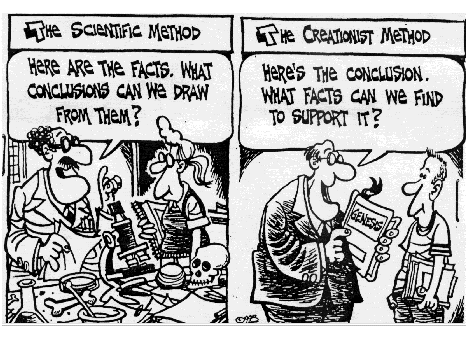
Care to show some prof ?nightwheel wrote:This is fact: The more science tries to prove the Bible is wrong. The more they prove it's right.
http://i10.photobucket.com/albums/a112/ ... ionist.gif
Moderator: Moderators
Care to show some prof ?nightwheel wrote:This is fact: The more science tries to prove the Bible is wrong. The more they prove it's right.
Here ya go:gamemasterAS wrote:Care to show some prof ?nightwheel wrote:This is fact: The more science tries to prove the Bible is wrong. The more they prove it's right.
http://i10.photobucket.com/albums/a112/ ... ionist.gif


nightwheel wrote:Here ya go:gamemasterAS wrote:Care to show some prof ?nightwheel wrote:This is fact: The more science tries to prove the Bible is wrong. The more they prove it's right.
http://i10.photobucket.com/albums/a112/ ... ionist.gif
http://www.telegraph.co.uk/news/main.jh ... let111.xml
http://www.ucgstp.org/lit/gn/gn047/biblewasright.htm
http://en.wikipedia.org/wiki/Ur
So by that process of thinking I can write a story about myself in my town and because both me and my town are real anything I write in that story is true ?nightwheel wrote:First, The city of Ur was found because of the acounts of it in the bible.
The one about the little tablet. It spoke of someone that was little known in the bible. And that little tablet proved he actulay extsted. And as for the other one. It was a little of everything I found to be trustworthy.
The Bible is not an accurate history book. The Bible contains passages describing events which could not possibly transpire, throwing the rest of the text into doubt. In addition to that, the different pieces of the bible have been rewritten countless times over the past 3000 years. Changes were made both accidentally- by monks copying the text by hand- and intentionally.Ok, lets look at the bible in this point of view. It's a acuret history book, phlospy book and a few other things but i can't rember them.
Science does not try to prove the Bible wrong, not in the way you mean. Science goes about its business showing us how the world works. If something conflicts with scientific understanding, and that something is proven through experimentation to be correct, then scientific understanding changes. Science has shown us that the wave of a hand, or contact with skin, can not turn water into wine, for instance. IF part of the Bible is wrong- which it is- than how can we trust the rest?This is fact: The more science tries to prove the Bible is wrong. The more they prove it's right.

An astute reader can also find false statements in science or history books. Does this same logic apply?IF part of the Bible is wrong- which it is- than how can we trust the rest?

That just seems like one large paradox to me, what did you gather out of it?marshallh wrote:I think you all need to realize something:
Faith is believing in something that science cannot verify.
My belief is personally grounded in things I have seen happen in other people. An example:
Back in 1999 my grandpa was diagnosed with terminal liver cancer. He developed four tumors which weakened him significantly. He prayed to share his belief with others. In a short time three of the four tumors went away. His doctor could not explain it.
During this time my grandpa was almost fully back to normal, he made a lot of new friends and shared his faith.
I remember going to Braum's for an ice cream cone. Technically he wasn't supposed to have any, but he was going to die eventually so he ate one with me. I enjoyed that.
Shortly thereafter he had finished telling all his friends about Jesus. Very soon the three tumors came back, and in a couple months he passed away. He had no regrets.
Now, I don't base my entire belief on this one incident. But, it certainly gave me something to think about.