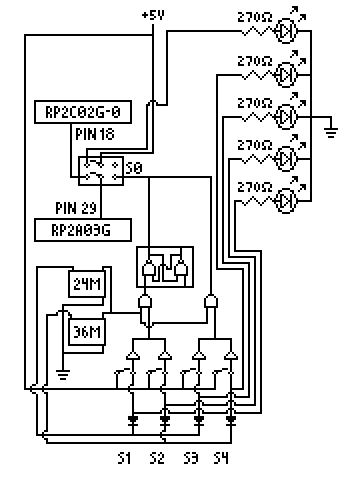
This is the simple one. It uses 1 master DPDT switch and four smaller switches to manipulate clock speed. It has two clock crystals as well, 24MHz and 36MHz.
The Master Switch toggles between the stock 1.79 MHz clock and toggle enable.
The smaller switches, once the 1.79 MHz clock is disabled at the Master Switch level, allow one to select one of four speeds.
1.0MHz ((24MHz/12)/2)
1.5MHz ((36MHz/12)/2)
2.0MHz (24MHz/12)
3.0MHz (36MHz/12)
This gives this NES two Underclocked settings, the Default setting, and two Overclocked settings. A seperate LED lights up for each setting.
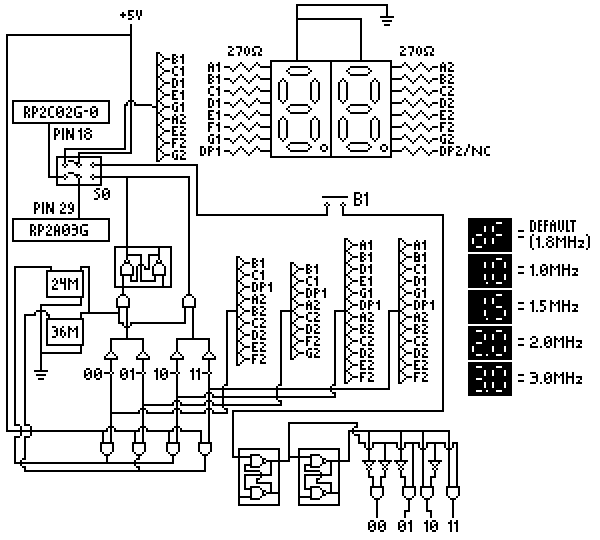
Here is the complex one. It controls clock speed the same way, but displays the clock sleed in numbers, and instead of four smaller switches, it has the Master and a push-button. The push button allows one to toggle through the settings, one the Master Switch is off of default, until the desired setting is found. The pushbutton may need a debouncing circuit.
I'm sure someone can find a way to get the display to work that doesn't require about 60 buffers though...
I do not guarantee this will work, and it is untested. Also, this must be set while your NES is off, so wire the 5V right to the 7805 or something, before the NES switch. If you try and change clock speeds while your NES is on...I couldn't tell you what would happen. Best case would be a crash, worst case, you'd fry your NES.
Another note: Make sure the flip-flop frequency divider used to halve the clock speed can handle MHz-level speeds. I think this shouldn't be a problem, but who knows.
Another another note: In the second schematic, the stock 1.79 MHz clock is displayed as "df" for default. It can be set to something different though, such as 1.8.
