Does anyone know of a diode that would restrict a 1/8" Stereo singal coming out of a PC per say to act like a one way valve. I have a project that requires this, I tried a 12V Zener Diode yesterday from Radioshack but it dosent seem to work.
http://www.radioshack.com/product/index ... Id=2049725" onclick="window.open(this.href);return false;
I am going to attempt to explain what I am trying to do, this is going to require some back story. At work we hve a massive flash soundboard we all use that I make and update regularly. All insults, vulgarity, and inside joke stuff. crap basically to make us laugh and get through the day. Needless to say we brought in a new boss, who now dosent like this, new people in the engineering bullpen who want it quiet. We dont want to stop the fun so I plan on running cabling between our machines and then have a small projectbox on our desks with a headphone hookup and a DPDT switch that will allow you to listen to your PC in "private" mode i.e. not transmitting to the other machines, and flip the switch and your "broadcasting" to everyone else. Now I need the diode to prevent the private loop from "backfeeding" down the main cable between the machines. However, I still want everyone to be able to hear the main broadcasts even when in private mode.
I hope I explained this correctly... at least enough to be understood.
Now I know the 12V diode was overkill going into this, its just a basic "headphone" signal I am trying to direct. I dont even know what the current profile is I cant even get it to register on my multimeter on voltage or amperage.
Any suggestions for a correct diode would be great, thanks.
Directing Headphone Signal
Moderator: Moderators
Directing Headphone Signal
I build rocket parts for a living... really
-
bicostp
- Moderator
- Posts: 10491
- Joined: Mon Mar 07, 2005 5:47 pm
- Steam ID: bicostp
- Location: Spamalot
- Contact:
Re: Directing Headphone Signal
Would something like this work?

The switch cuts your PC off from either the broadcast line or the headphones. When it's set to 'local' mode, the headphones are directly connected to the PC, but the bypass lets you hear anything on the broadcast line. When it's in 'broadcast' mode, you still hear your own PC over the broadcast wire, but not locally.
For the wiring, I suggest regular phone wire. If you can get enough phone connectors (gut them from those little Y adapters that let you plug 2 phones into 1 jack), use phone cabling. It's cheap and can carry stereo if you want it to.
How long will the entire cable run be?
The switch cuts your PC off from either the broadcast line or the headphones. When it's set to 'local' mode, the headphones are directly connected to the PC, but the bypass lets you hear anything on the broadcast line. When it's in 'broadcast' mode, you still hear your own PC over the broadcast wire, but not locally.
For the wiring, I suggest regular phone wire. If you can get enough phone connectors (gut them from those little Y adapters that let you plug 2 phones into 1 jack), use phone cabling. It's cheap and can carry stereo if you want it to.
How long will the entire cable run be?
Twitter
http://www.pcwgaming.com" onclick="window.open(this.href);return false;
If you want a Dropbox account, please use my referral link
http://www.pcwgaming.com" onclick="window.open(this.href);return false;
If you want a Dropbox account, please use my referral link
Re: Directing Headphone Signal
Hey thanks for the repsonse, your sketch and understanding is pretty darn close. I am adding the degree of complexity that when your on the "private loop" you can still here the broadcast line. If I can find the right diode I can set this up where the private loop wont backfeed down the broadcast loop.
Here is my circuit diagram:
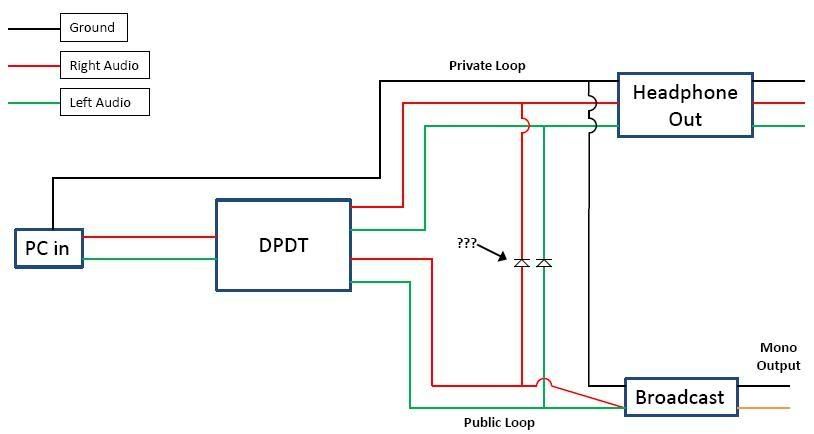
I am using regular 16 gauge speaker wire between the machines (simple and cheap), and the total length is 26 feet between the machines all along one wall. I have already made the long run and tested it. No sound degradation. Also you will notice that its a mono transition, yes I know. No biggie.
Here is my circuit diagram:
I am using regular 16 gauge speaker wire between the machines (simple and cheap), and the total length is 26 feet between the machines all along one wall. I have already made the long run and tested it. No sound degradation. Also you will notice that its a mono transition, yes I know. No biggie.
I build rocket parts for a living... really
Re: Directing Headphone Signal
As an update... I tried a 5.1V Zener Diode tonight, and it just blocks the whole signal. I think I need a smaller voltage diode. I'll likely have to order something off digikey.
Anyone have a better idea?
Anyone have a better idea?
I build rocket parts for a living... really
-
Rekarp
- Portablizer Extraordinaire
- Posts: 2163
- Joined: Thu Dec 28, 2006 1:52 am
- PSN Username: Lnghrn_
- Steam ID: rekarp
- Location: Austin, Tx
- Contact:
Re: Directing Headphone Signal
Um a Zener Diode will allow current through one way and block current the other way (like most diodes). The only difference is when theres enough reverse bias (higher voltage on the other side and in this case 5.1V) it breaks down and current can go the other way. I think you need to just switch your diode aroundrcullan wrote:As an update... I tried a 5.1V Zener Diode tonight, and it just blocks the whole signal. I think I need a smaller voltage diode. I'll likely have to order something off digikey.
Anyone have a better idea?

The wood master
"I was under the impression Mac owners don't actually USE their machines, they just parade them around trying to evangelize the masses."
"I was under the impression Mac owners don't actually USE their machines, they just parade them around trying to evangelize the masses."
Re: Directing Headphone Signal
I tried that... no dice. I am going to try and order a 2V diode from digikeyRekarp wrote:I think you need to just switch your diode around
I build rocket parts for a living... really
Re: Directing Headphone Signal
Am I missing something here? A diode will only let current travel in one direction, but that says nothing about whether a given signal can go in either direction - that depends on the signal. Rekarp, you should know better.
To do this you need either a four pole switch (or two DPDT switches) or an active circuit, a buffering circuit. But then you need a circuit to do the buffering, eg an opamp, and power source for that circuit.
To do this you need either a four pole switch (or two DPDT switches) or an active circuit, a buffering circuit. But then you need a circuit to do the buffering, eg an opamp, and power source for that circuit.
-
Rekarp
- Portablizer Extraordinaire
- Posts: 2163
- Joined: Thu Dec 28, 2006 1:52 am
- PSN Username: Lnghrn_
- Steam ID: rekarp
- Location: Austin, Tx
- Contact:
Re: Directing Headphone Signal
You can send a signal through a diode. All a signal is is a variable current/voltage. A diode won't care what it is till it reaches its peak reverse bias. I've passed analog audio through diodes before. A Schottky diode should work I think.nitro2k01 wrote:Am I missing something here? A diode will only let current travel in one direction, but that says nothing about whether a given signal can go in either direction - that depends on the signal. Rekarp, you should know better.
To do this you need either a four pole switch (or two DPDT switches) or an active circuit, a buffering circuit. But then you need a circuit to do the buffering, eg an opamp, and power source for that circuit.
The wood master
"I was under the impression Mac owners don't actually USE their machines, they just parade them around trying to evangelize the masses."
"I was under the impression Mac owners don't actually USE their machines, they just parade them around trying to evangelize the masses."
Re: Directing Headphone Signal
A Schottky diode is exactly what I have been looking at over the past few days. And I did a simple test seperate from this system and the 5.1V zeners will pass an audio signal through, very muffled though
I build rocket parts for a living... really
Re: Directing Headphone Signal
Well, I see two problems with this.Rekarp wrote:You can send a signal through a diode. All a signal is is a variable current/voltage. A diode won't care what it is till it reaches its peak reverse bias. I've passed analog audio through diodes before. A Schottky diode should work I think.nitro2k01 wrote:Am I missing something here? A diode will only let current travel in one direction, but that says nothing about whether a given signal can go in either direction - that depends on the signal. Rekarp, you should know better.
To do this you need either a four pole switch (or two DPDT switches) or an active circuit, a buffering circuit. But then you need a circuit to do the buffering, eg an opamp, and power source for that circuit.
1) The audio signal is an AC signal, so it will alternate between positive and negative voltages with respect to ground. The diode will have different characteristics depending on which region the signal is in. You'd have to bias the whole signal to fall into the peak reverse area, which does not seem like a feasible thing to do in this application. Or am I misunderstanding something?
2) Even so, the diode current/voltage is exponential, which will distort the signal. In fact, the only time when I've seen diodes used in an audio signal path is in guitar pedals where they were used exactly for this purpose.
-
Rekarp
- Portablizer Extraordinaire
- Posts: 2163
- Joined: Thu Dec 28, 2006 1:52 am
- PSN Username: Lnghrn_
- Steam ID: rekarp
- Location: Austin, Tx
- Contact:
Re: Directing Headphone Signal
Just because a signal oscillates does not mean it goes below the reference voltage. For your standard audio signal it stays above 0V. The whole signal will be under 5V so having a diode large enough is easy to come by. A Schottky Diodes C/V curve is fairly tame and and would only come into play if you where reverse biasing it which in this case we are not.nitro2k01 wrote:Well, I see two problems with this.Rekarp wrote:You can send a signal through a diode. All a signal is is a variable current/voltage. A diode won't care what it is till it reaches its peak reverse bias. I've passed analog audio through diodes before. A Schottky diode should work I think.nitro2k01 wrote:Am I missing something here? A diode will only let current travel in one direction, but that says nothing about whether a given signal can go in either direction - that depends on the signal. Rekarp, you should know better.
To do this you need either a four pole switch (or two DPDT switches) or an active circuit, a buffering circuit. But then you need a circuit to do the buffering, eg an opamp, and power source for that circuit.
1) The audio signal is an AC signal, so it will alternate between positive and negative voltages with respect to ground. The diode will have different characteristics depending on which region the signal is in. You'd have to bias the whole signal to fall into the peak reverse area, which does not seem like a feasible thing to do in this application. Or am I misunderstanding something?
2) Even so, the diode current/voltage is exponential, which will distort the signal. In fact, the only time when I've seen diodes used in an audio signal path is in guitar pedals where they were used exactly for this purpose.
The wood master
"I was under the impression Mac owners don't actually USE their machines, they just parade them around trying to evangelize the masses."
"I was under the impression Mac owners don't actually USE their machines, they just parade them around trying to evangelize the masses."
Re: Directing Headphone Signal
It is exactly this that I disagree with. On every sound output I've come across, there has been a coupling capacitor in series with the signal to remove any DC offset. (Basically a passive high-pass filter) This design makes sense for driving headphones(or other speakers): Having a constant DC offset on the signal will also produce a constant DC current through the speaker coil which might eventually burn the speaker. It also makes sense for a line level signal which is typically defined to swing between -1 V and +1 V peak-to-peak. Having a DC offset on a line level signal signal might also be a bad thing if the receiving input does not have coupling capacitors, since it might mean that the signal reaches outside of the defined signal range, creating clipping.Rekarp wrote:Just because a signal oscillates does not mean it goes below the reference voltage. For your standard audio signal it stays above 0V.
So in short, I challenge you to display a practical, real life example of an audio output circuit which deliberately has a DC offset. Then make a case for why rcullan's equipment would be designed in this way.
-
Rekarp
- Portablizer Extraordinaire
- Posts: 2163
- Joined: Thu Dec 28, 2006 1:52 am
- PSN Username: Lnghrn_
- Steam ID: rekarp
- Location: Austin, Tx
- Contact:
Re: Directing Headphone Signal
hmm which would explain why his audio signal would be so quite.nitro2k01 wrote:It is exactly this that I disagree with. On every sound output I've come across, there has been a coupling capacitor in series with the signal to remove any DC offset. (Basically a passive high-pass filter) This design makes sense for driving headphones(or other speakers): Having a constant DC offset on the signal will also produce a constant DC current through the speaker coil which might eventually burn the speaker. It also makes sense for a line level signal which is typically defined to swing between -1 V and +1 V peak-to-peak. Having a DC offset on a line level signal signal might also be a bad thing if the receiving input does not have coupling capacitors, since it might mean that the signal reaches outside of the defined signal range, creating clipping.Rekarp wrote:Just because a signal oscillates does not mean it goes below the reference voltage. For your standard audio signal it stays above 0V.
So in short, I challenge you to display a practical, real life example of an audio output circuit which deliberately has a DC offset. Then make a case for why rcullan's equipment would be designed in this way.
The wood master
"I was under the impression Mac owners don't actually USE their machines, they just parade them around trying to evangelize the masses."
"I was under the impression Mac owners don't actually USE their machines, they just parade them around trying to evangelize the masses."
Re: Directing Headphone Signal
Diodes for audio signals? Come on guys, there's almost a page of replies about what kind of diode to use and nitro is the only one who realized that you /cant use a diode/. Its AC! Everyone should know that! In fact, you people ALWAYS try to use diodes where you shouldn't. We should make a semiconductor sticky....
As far as I know there's no such thing as a general "check valve for analog signals". You design your system so each signal only has one driver, end of story. If you want to drive the same signal from multiple places then you have to have a way to make sure only one driver is connected at any time. Think about telephone switchboards...
If you are saying you want people in different cubicles to be able to drive the same intercom line, then everyone is basically going to have to agree to go one at a time. If you are saying you also want to be able to hear the sound from your computer AND the sound on the intercom... well then you are going to need some kind of mixer or something too... Or one line in each ear...
Why dont you just write software to do it man, you are all on a network anyways. Use one of those chat software dealies like ventrilo?
As far as I know there's no such thing as a general "check valve for analog signals". You design your system so each signal only has one driver, end of story. If you want to drive the same signal from multiple places then you have to have a way to make sure only one driver is connected at any time. Think about telephone switchboards...
If you are saying you want people in different cubicles to be able to drive the same intercom line, then everyone is basically going to have to agree to go one at a time. If you are saying you also want to be able to hear the sound from your computer AND the sound on the intercom... well then you are going to need some kind of mixer or something too... Or one line in each ear...
Why dont you just write software to do it man, you are all on a network anyways. Use one of those chat software dealies like ventrilo?

"Linux is only free if your time is worthless"